Supporting clients with puppy power
Paw Pause founder Niki draws on her lived experience as a woman with disability to get the best outcomes for clients
Niki Pryke knows exactly what it takes to connect with a student who’s anxious to be at school. It’s puppy power.
“Some of our clients struggle beyond belief to be at school,” Niki says.
“They can’t eat, won’t go to the toilet and they really struggle to be in the classroom – so you can understand why learning with their peers is nearly impossible.
“But even the teenagers that have a very tough exterior, and they talk in that teenage way, they really connect with our therapy dogs. They are so respectful to the handler and dog in that situation, in a way that doesn’t happen with parents and teachers.
“Dogs really fast track our connections with the students. They don’t necessarily know – or care – that Paw Pause handlers are allied-health qualified. When we’re with our therapy dogs, we’re not a threat and we’re just building a connection naturally.
“Then, when that student is feeling safe and regulated they are going to learn. It’s positive, instead of heightened anxiety.”
Understanding education
Niki has worked in schools for more than 20 years, first as a student support officer (SSO), supporting students with disabilities, as a youth worker and counsellor. She’s also worked in child care and as a swimming instructor – working with children is her life’s work.
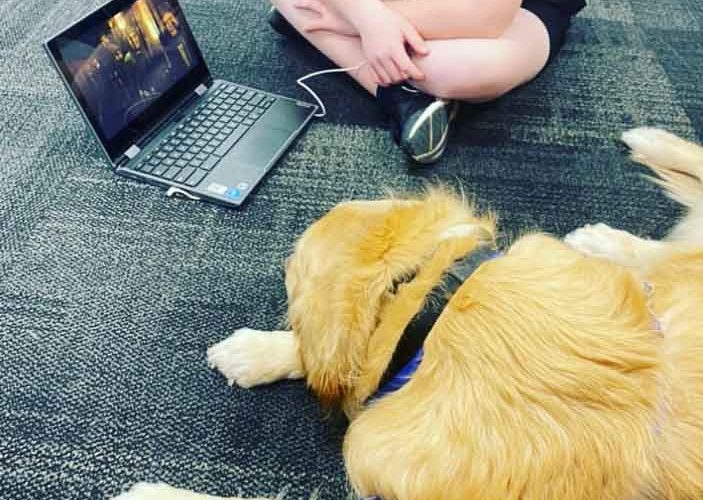
Then, as she was training her Golden Retriever Ed as a therapy dog, Niki started bringing him with her as she supported students – and noticed a dramatic change.
“I realised when Eddie was there I was getting more conversation out of students, they were more relaxed and it just brought down their anxiety levels when they were having a session with me,” Niki says.
It was the disconnection of lockdowns during Covid that Niki realised students were really struggling to return to school – as experienced across the nation.
“Covid changed everything in schools and I knew I’d be able to deliver a service for students with Eddie to help them feel better about being back at school.”
From this need, Paw Pause was born.
Creating Paw Pause
However, Niki then experienced her own health crises and began training Eddie as an Assistance Dog – his new qualification means he is permitted to be with her in all public places – and, from her own lived experience of disability and also being an NDIS participant, she founded Paw Pause.
“There is disability in my extended family but that’s not my story to tell. My personal lived experience of disability came in 2021, just after I started Paw Pause. I was diagnosed with five autoimmune diseases which affect my mobility, stamina and create physical symptoms. I became an NDIS participant in 2022,” she says.”
Niki brought on other allied health professionals who have their own trained therapy dogs to support students in schools as part of the Paw Pause team. All teams are subcontractors who abide by the consistent high standards and policies of Paw Pause, and Animal Therapies Limited.
The key goal of Paw Pause is client welfare and Niki and her team are committed to supporting NDIS participants and their families, while working as part of the student’s school-based team.
Drawing on lived experience
As an NDIS participant herself, Niki truly understands what students and families are going through, as well as how to best support students in the classroom.
It’s the perfect balance.
“I’m still very passionate that they get the supports that they need and I support them and advocate as much as I can,” Niki says.
“That’s what drives me, making sure they are supported, that they have choice and control. I’m so passionate about making sure the students we work with are able to get the supports they need individually.
“The NDIS can be amazing, but it can also be exhausting, it’s complicated and for a lot of the clients and their families they are baffled and overwhelmed, so I feel like I can offer a little bit more insight into those things.”
Harnessing the magic of dogs
Understanding each participant’s needs, their family’s experience and how to work effectively in schools is key to the Paw Pause experience.
Niki says a Paw Pause trained therapy dog and allied health handlers are able to fast-track connection with students.
“For a lot of children and teens with disability, their experience is having a lot of adults in their lives who do things with them, or alongside them, and that’s fantastic at times but it’s also not the typical experience of growing up.
“Dogs change the power dynamic, so it’s not just an adult and a child together. Paw Pause dogs are calm, they help create a sense of safety and support relationship building. When students are feeling emotionally safe with us and able to rely on our support, it gets them into a state where they are ready to learn – you can’t learn when you’re not regulated.”
Working as part of the school team
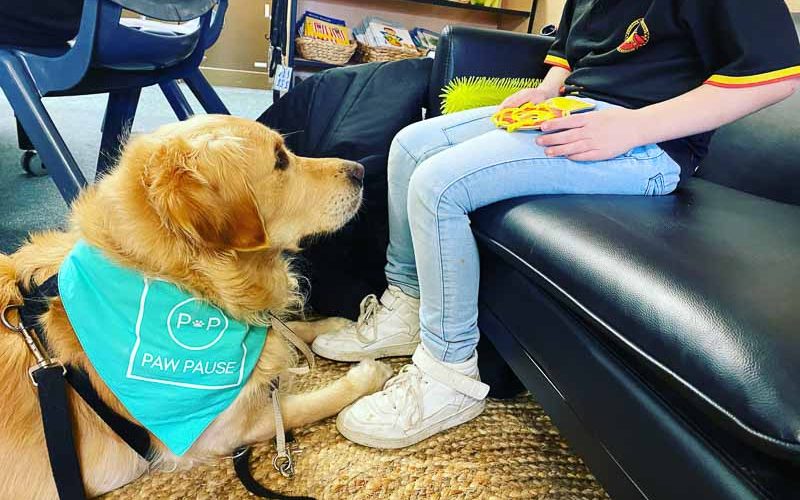
Paw Pause dogs are trained therapy dogs, which means you’ll never see them running free, playing on the oval or acting like a pet dog.
They’re always on the lead and under the care of their allied-health qualified handler. And Paw Pause teams are aiming to be in the classroom with the client so they are regulated and able to learn and participate in the classroom with their peers.
“The beauty is while our teams work under the direction of the teacher, we don’t add to the workload,” Niki says.
“Our focus is about supporting regulation and readiness. And rather than having someone from leadership bring in a pet – and taking them away from their regular work – we just decrease the workload of staff by being a calming presence and an extra, qualified adult who is there to support our client.”
The privilege of Paw Pause
Niki says supporting students to feel safe at school with Paw Pause has been the biggest privilege of her professional life.
“I’ve previously worked with a child in care who really struggled with emotional regulation, which is understandable given her life experiences to date,” Niki says.
“Ed and I came in for a morning session and she had had a really tough morning. She was so dysregulated with the transition from home to school she was acting out physically and using furniture to get her emotions out.
“It’s really distressing for her to be so out of control, we understand that, and Ed knew straight away what she needed. I talked to her for a little bit just to stop the furniture throwing and ensure a safe environment for all of us.
“We found a seat together on a comfy sofa where Ed proceeded to put his head on her leg with deep pressure and then she could pat him. As she patted him she was quiet and her tears and swearing stopped. She did that herself once she had Ed, she was able to regulate within about 10 minutes which is amazing.
“You have to have that relationship with the young person for them to allow you to sit next to them in these really vulnerable moments.
“Then she was able to return to the classroom and work under the instruction of their teacher. We stayed with the student and supported them to remain calm for the rest of the session.
“Reflecting on it, I feel so privileged to be that trusted adult in our clients’ lives. Sometimes we are the only one in their life and that’s why they want to come to school.”
Do you know a student who could benefit from the support of a Paw Pause team? Contact us for more information.